Szeto SS, Reinke SN, Sykes BD, Lemire BD. Ubiquinone-binding site mutations in the saccharomyces cerevisiae succinate dehydrogenase generate superoxide and lead to the accumulation of succinate.
J Biol Chem. 2007 Jul 18; PMID: 17636259
Thursday, July 26, 2007

Firmer evidence for involvement of Complex II in Huntingtons
Benchoua A, Trioulier Y, Zala D, Gaillard MC, Lefort N, Dufour N, Saudou F, Elalouf JM, Hirsch E, Hantraye P, Déglon N, Brouillet E.
Involvement of mitochondrial complex II defects in neuronal death produced by N-terminus fragment of mutated huntingtin.
Mol Biol Cell. 2006 Apr;17(4):1652-63.
Involvement of mitochondrial complex II defects in neuronal death produced by N-terminus fragment of mutated huntingtin.
Mol Biol Cell. 2006 Apr;17(4):1652-63.
Friday, June 1, 2007
New Article
Baysal BE, Lawrence EC, Ferrell RE.
Sequence variation in human succinate dehydrogenase genes: evidence for long-term balancing selection on SDHA.
BMC Biol. 2007 Mar 21;5:12. PMID: 17376234
Sequence variation in human succinate dehydrogenase genes: evidence for long-term balancing selection on SDHA.
BMC Biol. 2007 Mar 21;5:12. PMID: 17376234
New Complex II Polymorphism database:
Database address:
http://chromium.liacs.nl/lovd_sdh/
Publication:
Jean-Pierre Bayley, Peter Devilee1, and Peter EM Taschner.(2005) The SDH mutation database: an online resource for succinate dehydrogenase sequence variants involved in pheochromocytoma, paraganglioma and mitochondrial complex II deficiency
BMC Medical Genetics 2005, 6:39 doi:10.1186/1471-2350-6-39
Saturday, May 19, 2007
Recent Article: Complex II in leukemia?
A Recurrent Stop-Codon Mutation in Succinate Dehydrogenase Subunit B Gene in Normal Peripheral Blood and Childhood T-Cell Acute Leukemia.
Bora E. Baysal, May 2007, PLoS ONE Online Journal
Bora E. Baysal, May 2007, PLoS ONE Online Journal
Thursday, May 10, 2007
Wolinella succinogenes QFR has a cis-Asp!
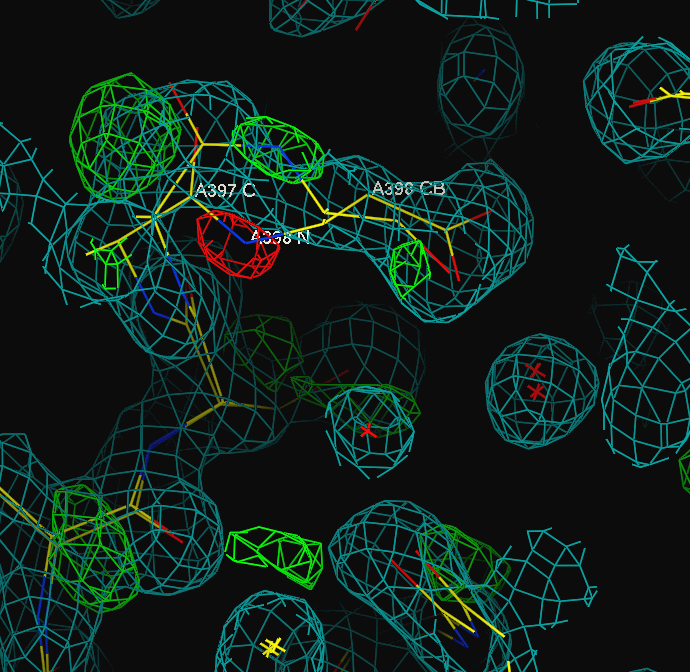 (larger image)
Wolinella succinogenes QFR flavoprotein has a cis-Asp! Model w atom labels is 2BS2, maps calculated with phases from it using SF's sf2bs2.cif. Other model is chicken complex II, superimposing the FAD domain. Green and red maps are positively and negatively contoured Fo-Fc maps- green on the chickenmodel shows where the atom should be, red on the Wolli atom shows it is misplaced. Apparently this cis-peptide occurs in all membrane-bound SDH/QFR enzymes solved to date. Soluble FCc FRD from Shewanella has a deletion here and no cis-peptide. The cis-peptide introduces a bulge which accomodates the extra residue. This is near the active site and an enigmatic conserved protein-bound metal ion (yellow crosses at bottom center).
Saturday, March 24, 2007
Recent Article
Dicoumarol impairs mitochondrial electron transport and pyrimidine biosynthesis in human myeloid leukemia HL-60 cells. Biochem Pharmacol. 2007 Feb 1;73(3):427-39. Epub 2006 Oct 21.
PMID: 17123468
(Dicoumarol stimulates ROS production, potentiated by Complex II Q-site inhibitors.)
Subscribe to:
Posts (Atom)